Short answer: They didn’t remove “catholic” from the Creed. “Holy Christian Church” is the translation of “catholic” in this context — it was already the accepted German rendering of the word centuries before Martin Luther was born.
If you’ve ever worshipped with us here at the Church of the Augustana, you’ve recited these words from our the Apostles’ Creed: “I believe in the Holy Ghost; the holy Christian Church, the communion of saints…” — not “the holy catholic Church,” the way many English-speaking Christians say it. It’s a fair question, and one people ask more often than you’d think: did Luther delete a word from an ancient creed to distance himself from Rome?
The historical answer is no. And the real story behind the phrase holy Christian Church is more interesting — and more theologically important — than a simple word swap.
“Catholic” Was Never a Denominational Word
Long before there was a “Roman Catholic Church” as a distinct branch of Christianity, the word catholic simply meant universal — from the Greek katholikos, “according to the whole.” When the early church confessed belief in “the catholic church,” they meant one specific thing: the whole body of believers, in every place and every age, as opposed to any one local congregation or splinter group that had broken away into heresy or schism.
In that sense, “catholic” was never meant to name a particular church — Roman, Eastern, or otherwise. It was a claim about scope: the church is not confined to one city, one nation, or one era. It’s the same church running “from Abel,” as the ancient formula puts it — Christians of every generation, back to the first believer in Genesis, joined by one and the same faith in Christ.
This is precisely why the phrase holy Christian Church appears in the Third Article of the Creed rather than “holy Roman Church” or “holy [any-particular-communion] Church.” The Creed was never describing an institution headquartered anywhere. It was describing everyone, everywhere, who holds the one true faith.
Where the Phrase “Holy Christian Church” Actually Comes From
Here’s the part most people don’t know: German-speaking Christians were already reciting the Creed as “Ich glaube eine heilige christliche Kirche” — “I believe there is one holy Christian church” — in texts that predate the Reformation entirely. This wasn’t a Lutheran invention. “Christian” had simply become the accepted German rendering of catholica long before Luther’s time, the same way a translator today chooses the clearest word in the target language rather than transliterating the original untranslated.
Martin Chemnitz, one of the great Lutheran theologians of the generation after Luther, made exactly this point when Roman apologists accused Lutherans of tampering with the Creed to suit their own agenda. His answer: nothing had been deleted. The “holy Christian church”, a faithful synonym was already doing the job, in ordinary use, well before the controversy ever began.
This matters more than it might first appear. Rome’s own catechism at the Council of Trent leaned hard on etymology to draw sharp lines between Christian and Jewish worship, and between “true” and “false” churches more broadly. Lutheran theologians of the same era — men like Johann Gerhard, writing systematically on the doctrine of the church a century later — spent enormous effort showing that these etymological and terminological distinctions often collapsed under scrutiny. Words like “church,” “synagogue,” “catholic,” and “Christian” had shared, overlapping histories in Scripture itself; they weren’t proof texts for one communion’s exclusive claim to the title.
What “Holy Christian Church” Actually Confesses
So what is the phrase “holy Christian church” actually protecting, if not a swipe at Rome? Four things, and they’re worth knowing by heart:
1. It’s not confined to one nation or one place. Unlike Old Testament Israel, tied to one people and one temple, the New Testament church gathers “without distinction of peoples, places, and persons,” wherever the gospel is preached and the sacraments rightly administered — which is exactly why our own congregations span the Philippines, Singapore, Australia, and Vietnam rather than a single national church.
2. It’s the sum of every true local church. The “catholic epistles” (Peter, John, James) weren’t written to one congregation — they were addressed to believers everywhere. The holy Christian Church works the same way: it’s constituted by every congregation, in every place, that confesses the true faith, not by administrative connection to one see or city.
3. It’s measured by the catholic faith, not loyalty to an institution. The ancient test, going back to the fifth-century monk Vincent of Lérins, was universality, antiquity, and consent: has this been believed everywhere, always, by all? A church earns the right to call itself catholic — universal, Christian — by teaching what the whole church has always taught, not by claiming the title or the throne.
4. It stands against heresy and division. Anyone who departs from that universal, apostolic consensus — however large or impressive their own following — has stepped outside the true, catholic, Christian faith, whatever they choose to call themselves.
Read together, these four claims explain why our own statement of belief describes the Lutheran Confessions as “an accurate expression of the true Christian, catholic and historic faith of Christ’s Church, as taught in the Bible.” That phrasing is the same conviction the Reformers held: Lutheranism was never meant to be one denominational “option” alongside others. It was, and is, a claim to simply be teaching and practicing what the holy Christian Church has always taught, “minus any aberrations to the right or to the left of Holy Scripture.”
Is the Lutheran Church “Catholic”? A Common Follow-Up Question
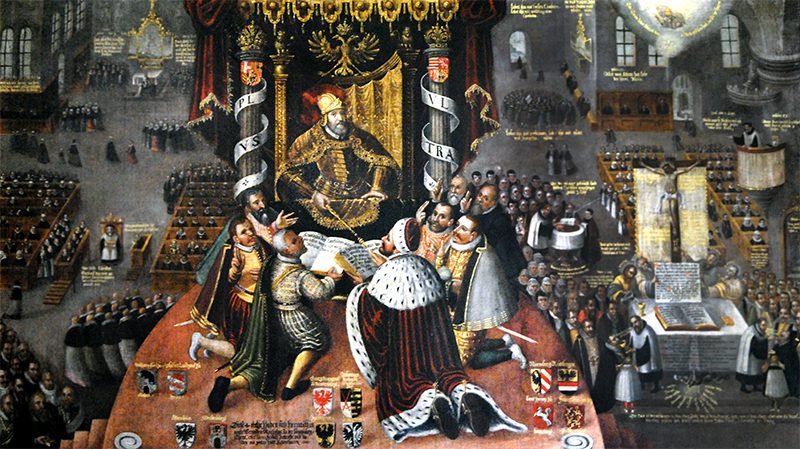
Short answer: in the original, historic sense of the word — yes, and confessedly so. The Lutheran Confessions, gathered in the Book of Concord (1580), were never written to found a new church. They were written to demonstrate that the doctrine and practice being reformed was, in fact, the ancient, catholic, apostolic faith — and that certain late-medieval innovations had drifted from it. Whether a particular communion is “catholic” in the true sense, the Reformers argued, is settled by fidelity to the whole historic Christian faith, not by a title on a letterhead.
Why This Distinction Still Matters Today
It’s tempting to file this away as a linguistic curiosity — interesting trivia about a fourteenth-century German translation choice. But it touches something with real weight for how you think about your own faith and your place in Christ’s church.
When you confess the holy Christian Church in the Creed, you’re not confessing membership in a particular building, a particular denomination, or a particular nation’s state church. You’re confessing something both larger and more personal: that wherever the gospel is truly preached and the sacraments are rightly administered — a small mission congregation in Navotas, a gathering in Singapore, a parish half a world away — the same one church is present, the same Holy Spirit is calling, gathering, and sanctifying believers, and you belong to that whole company, not merely to your own local pew.
Frequently Asked Questions
What does “catholic” mean in the Apostles’ Creed? It means “universal” — the whole body of believers in every place and time, not a reference to any single denomination or institution.
Did Martin Luther remove “catholic” from the Creed? No. German-language versions of the Creed already used “Christian” (christliche) as the accepted translation of “catholic” (catholica) before the Reformation began. Nothing was deleted.
Why do Lutherans say “holy Christian Church” instead of “holy catholic Church”? Because “Christian” was already the standard German equivalent of “catholic” in common use, and Lutheran catechisms simply preserved that existing translation rather than introducing a new one.
Is the Lutheran Church catholic? In the historic sense of “catholic” — holding the universal, ancient, apostolic Christian faith — the Lutheran Confessions explicitly claim to be exactly that: a faithful exposition of the one holy Christian Church’s teaching, not a new or separate tradition.
Want to go deeper? Read the full text of the Creed in our Small Catechism, explore our confession of faith, or dig into the Compend of Lutheran Theology for a fuller treatment of these doctrines.