In short: Scripture uses “Body of Christ” in two connected ways — for the Church (all believers united to Christ as their Head) and for the Sacrament of the Altar (the true body of Christ given in, with, and under the bread). They aren’t unrelated. Paul deliberately ties them together in 1 Corinthians 10:17: “we who are many are one body, for we all partake of the one bread.”
If you’ve heard the phrase “Body of Christ” and weren’t sure which meaning was intended, you’re not alone — it’s one of the few pieces of Christian vocabulary that genuinely does double duty in Scripture, and both meanings matter for how we understand the Christian life.
Meaning 1: The Body of Christ Is the Church
The most common use of “Body of Christ” in the New Testament describes the Church — every believer, in every place, united to Jesus Christ the way a living body is united to its head.
“And He put all things under His feet, and gave Him as head over all things to the church, which is His body.” — Ephesians 1:22–23
“Now you are the body of Christ, and individually members of it.” — 1 Corinthians 12:27
The image does real theological work, not just decorative work. A body has one head directing it, many different members with different functions, and one life (one Spirit) animating the whole thing. Paul spells this out at length in 1 Corinthians 12: an eye can’t say to a hand “I have no need of you” (v. 21); when one member suffers, all suffer with it (v. 26); the gifts are different, but the Spirit giving them is the same (vv. 4–11).
Why “Head” matters as much as “Body.” Christ isn’t one member among many — He’s the Head, in a category by Himself. He alone supplies life, direction, and defense to the whole body (Colossians 1:18, Ephesians 4:15–16).
This is also why Lutheran theology has historically resisted the idea of any earthly “vicar” standing in Christ’s place as head of the Church — Scripture describes one Head, ruling His body directly by His Word and Spirit, not through a substitute.
A body has both a visible shape and an invisible life. Augustine pictured this with a simple comparison: a body has a physical form and an animating soul. The Church’s “body,” he said, is her outward fellowship — the preaching of the Word and the use of the Sacraments, which anyone can see. Her “soul” is the inward gifts of the Spirit — faith, hope, love — which only God can see.
This is exactly what we confess when we say, in the words of our own Creed, that we believe in “the holy Christian Church, the communion of saints” — one body, gathered visibly, united invisibly.
The Church’s story even follows the shape of Christ’s own body. Older Lutheran writers on this doctrine, like Johann Gerhard, noticed that what happened to Christ’s own physical body keeps happening, in a spiritual sense, to His Church. His body grew from infancy to full maturity — and Paul says the Church likewise grows “to the measure of the stature of the fullness of Christ” (Ephesians 4:13).
His body suffered before it was glorified — and the Church, too, carries the cross in this life before she shares His glory (Colossians 1:24). And His body had, by the world’s standards, an unimpressive, even contemptible outward appearance (Isaiah 53:2) — which is exactly why the Church so often looks small, ordinary, or overlooked from the outside, even while she is, inwardly, “all glorious” (Psalm 45:13).
If your church or your faith ever feels unremarkable next to the world’s standards of size and spectacle, that’s not a sign something’s wrong — it’s the same pattern Christ’s own body wore first.
Not every visible member is a living member. Scripture is honest that not everyone who sits in a pew is spiritually alive to Christ the way a healthy limb is alive to the body. Jesus’ own parables describe a mixed field — wheat and weeds growing together until the harvest (Matthew 13:24–30), good and bad fish gathered in one net (Matthew 13:47–50).
The ancient theologians described this with a simple image: a body can have healthy, living tissue and also carry things that don’t truly belong to its life — present, outwardly attached, but not actually alive with it. A living member of Christ’s body is one who is inwardly, actually united to Him by faith — not merely someone who shows up, but someone who is, in the deepest sense, grafted in (John 15:5). This is a sobering thought, but also a freeing one: church membership was never meant to be about outward performance. It’s an invitation to the real thing — actual, living union with Christ, not merely association with His people.
Meaning 2: The Body of Christ Is the Sacrament of the Altar
The second, equally biblical use of “Body of Christ” is much more direct — it’s what Jesus Himself calls the bread at the Last Supper:
“Take, eat; this is My body, which is given for you. This do in remembrance of Me.” — Luke 22:19
Our own Small Catechism states it plainly: “It is the true body and blood of our Lord Jesus Christ, under the bread and wine for us Christians to eat and to drink, instituted by Christ Himself.” When Christians receive Holy Communion, they receive Christ’s own body and blood — not merely a symbol or a memory aid, but, in Christ’s own words, His body, “given for you… for the forgiveness of sins.” This confession of the Real Presence has been a settled article of the Lutheran faith since the Reformation itself.
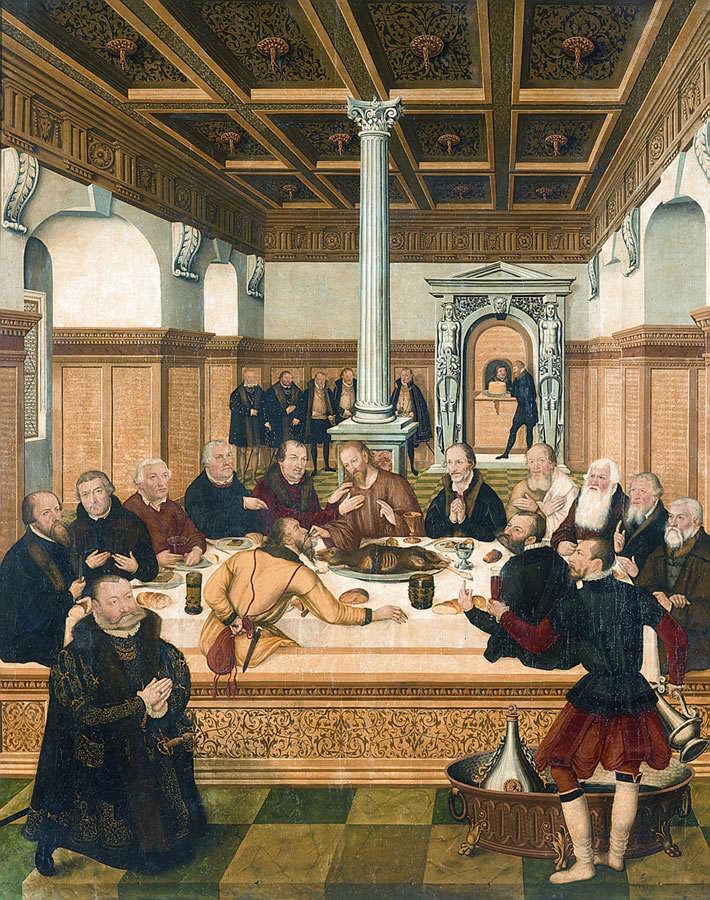
This is also why the phrase “Body of Christ” is spoken at Communion in many liturgical churches — the pastor says the words “the Body of Christ, given for you” as the bread is distributed, a direct echo of Christ’s own institution.
How the Two Meanings Connect — On Purpose
Here’s the part that’s easy to miss, and genuinely beautiful once you see it: Paul doesn’t treat these as two unrelated uses of one phrase. He ties them together directly:
“The cup of blessing which we bless, is it not the communion of the blood of Christ? The bread which we break, is it not the communion of the body of Christ? For we, though many, are one bread and one body; for we all partake of that one bread.” — 1 Corinthians 10:16–17
In other words: the Church is the Body of Christ because she feeds on the Body of Christ. Receiving the same true body of Christ at the same altar is part of what actually unites believers into one body, the Church. The sacramental Body of Christ and the ecclesial Body of Christ aren’t two coincidentally identical phrases — they’re two aspects of one reality, the same way a family shares one table and thereby remains one family.
This is part of why we describe ourselves as a sacramental church: Word and Sacrament aren’t add-ons to church life, they’re how Christ actually builds and sustains His body in the first place.
Frequently Asked Questions
What does “Body of Christ” mean in the Bible? It refers to two connected things: the Church (all believers united to Christ as Head, especially in Ephesians and 1 Corinthians 12) and the bread of Holy Communion, which Christ Himself identified as His body (Luke 22:19).
Why is the Church called the “Body of Christ”? Because believers are united to Christ, their Head, the way a living body is joined to its head — sharing His life, direction, and purpose, and joined to one another as fellow members (1 Corinthians 12:12–27).
Is “the Body of Christ” the same as the Lord’s Supper? The Lord’s Supper is where Christians receive the true body of Christ, given under the bread, as Christ instituted (Luke 22:19; 1 Corinthians 11:23–25). It’s a distinct but related meaning from “Body of Christ” as a title for the Church.
What is the connection between the Lord’s Supper and the Church as the Body of Christ? Paul draws the connection directly in 1 Corinthians 10:16–17: because believers share the one bread — Christ’s true body — they are made one body, the Church.
Read more: The Creed, from our Small Catechism · The Sacrament of the Altar · Our Beliefs