Grace, mercy, and peace from God our Father, and the Lord Jesus Christ, his dear Son, our Lord, be with you all. Amen.
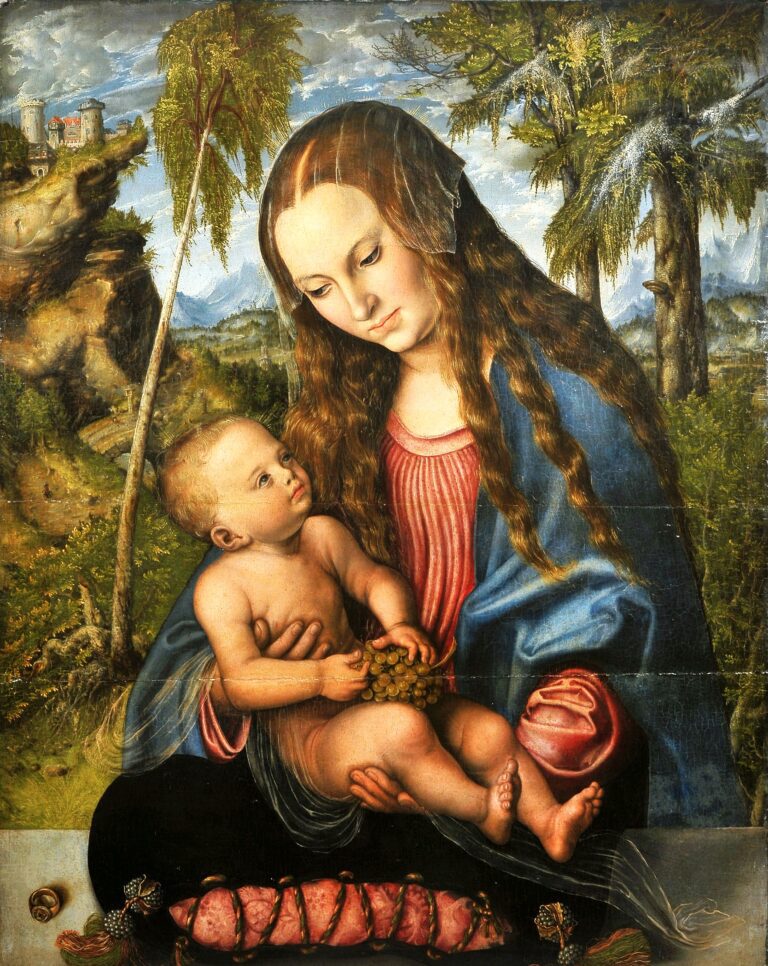
Today we celebrate the solemnity of the Dormition of the Blessed Virgin Mary, often celebrated especially within the Philippines, which is my country, as the Assumption, as the Roman Catholics call it. The way that we believe in this extra-biblical tradition is as follows.
It is believed by the Church, for millennia, that the Virgin Mary was assumed into heaven upon her death, meaning that she did not face corruption, as Elijah and Enoch have not. Although not explicitly written in the Holy Scriptures, the Church has held on to this tradition and belief as a foretaste of what will happen to all who believe in Christ.
Mary, of course, the Blessed Mother of our Lord, is the face and the image of the Church, meaning that she represents all Christians by virtue of her being the first to believe in Christ, and to believe in Christ as her Savior. We can see our very confession in the Annunciation itself: it is not by her own will and knowledge that she knew she would be the Mother of God. This was presented to her by the word of the angel Gabriel, meaning that even Mary had to receive salvation from the outside. Hence, her image as the Church gives us a glimpse of our own journey on earth.
Here we celebrate her dormition. More formally, we celebrate this feast day, as a diocese, as the Feast of Mary, the Mother of God, because we believe that feast days are celebrated on the day a saint dies. We believe that Mary, like any other Christian, also faced death — although our counterparts, Rome and the Papacy, insist that she did not, because they believe she is sinless. It is peculiar, then, that even Saint Thomas Aquinas himself did not hold to this, nor did Luther. Traditionally, Lutherans held to what we call the Immaculate Purification, though we don’t even hold that as doctrine — only as pious opinion.
All of these things, whether useful for the Church or not, exist to teach us one lesson, and to bring us to one turning point: to always point to Christ. Mary, as many titles as she may have, does not point to herself. None of her titles point to herself — they point to what Christ has done for her, and therefore what he will do for us. Elevating Mary to any position is not meant for us to see her as different from us, but to see her as one of us: as Christ has lifted her up and saved her from sin, death, and the evil of this world, so he will also do for us. Just as Mary had the faith to say in the Magnificat, “My soul rejoices in the Lord my Savior,” that very same prayer is ours as well. In the waters of baptism we make this confession, and in the sacrament we make this confession also.
The Mother of our Lord, then, as Luther proclaims, is also our mother — not because she gave birth to us, but because she was the first, and because she is the face of the Church. Again, all of these titles are not meant to be seen as doctrine, but as a reflection of our journey as Christians. All that Mary went through in this world is what we go through now, and as tradition holds that she was assumed into heaven, body and soul, so shall we be. This is part of our confession: the resurrection of the dead and the life everlasting.
All of this, everything we attribute to her, comes back to and points to her Son, whom we remember and worship today. Any mention of Mary should always point back to Christ, and never to her, and the dogmas surrounding her in Rome should never stop us from looking to her to see our own state — to see how her Son has saved her, and thereby how he has saved us.
The beauty of the life and humility of the Blessed Virgin Mary mirrors what we are and what we should be as Christians: always yielding, always obeying — not because of our own strength or power, but because Christ came to us first, just as he came to Mary through the conception of her Son at the Annunciation, through the wilderness she had to journey — to Egypt, to Bethlehem, and even to the foot of the cross. Her journey, then, is also our journey, and this is why the Virgin Mary remains prominent even within our churches. She is not to be shelved; she is not to be ignored — not because she is, as the Roman Catholics say, the Mediatrix of All Graces and all of that, but because she is our mirror as Christians. We see what Christ promises us by looking at what he has done for her. And if the tradition is true that Christ assumed her into heaven, so shall it be done for us. And if it has not yet happened to her, it will still be true in the resurrection of the dead — whether it happened two thousand years ago or will happen in the future, the fact remains the same: whatever Christ has done for his mother will also be done for us. That is the beauty of this blessed feast day.
Whether or not you hold to this pious opinion is not the point of this feast day, but rather what it conveys to us as Christians. The promises Christ has fulfilled in Mary are also fulfilled for us, the Church, because the very same promises Christ made to her mother are the promises being fulfilled for us as well.
Mary, too, received her Son again in Communion, in the Book of Acts. We assume this because she was present in the meeting place. We know that she carried her faith throughout, and we know that she remained with the Church during that time as well — her faith persisted, and therefore our faith persists, because the faith of the Mother of God is the faith we hold as well. Placing her on equal footing with us does not diminish her, as our adversaries claim. The Roman Catholics say that we diminish her, but this is not so. Their obsession with her has placed her far above everyone, out of reach for some. We acknowledge that she walks with us truly, because we walk where she has walked. We are at the foot of the cross each Sunday, just as she was, literally, at the time of Christ’s death. And we are there also when he is resurrected, just as she was.
All of these things remain true for her, and therefore remain true for us.
And may the peace of God, which passes all understanding, keep your hearts and minds in Christ Jesus our Lord. Amen.