Grace, mercy, and peace from God our Father, and the Lord Jesus Christ, His dear Son, our Lord, be with you all. Amen.
Our Gospel reading today is about the weeping Savior who approaches Jerusalem — not in glory, and not even in a claim to a political throne like many expect Him to be, especially the Jews, who even now still expect a Savior, an earthly King. Instead, He arrives in agonizing sorrow. He looks at Jerusalem, the Holy City, the place where God’s name dwelt, and He weeps. He weeps because Jerusalem did not know the time of her visitation. They were blind to the peace God was offering them in Christ, choosing instead the path of self-destruction.
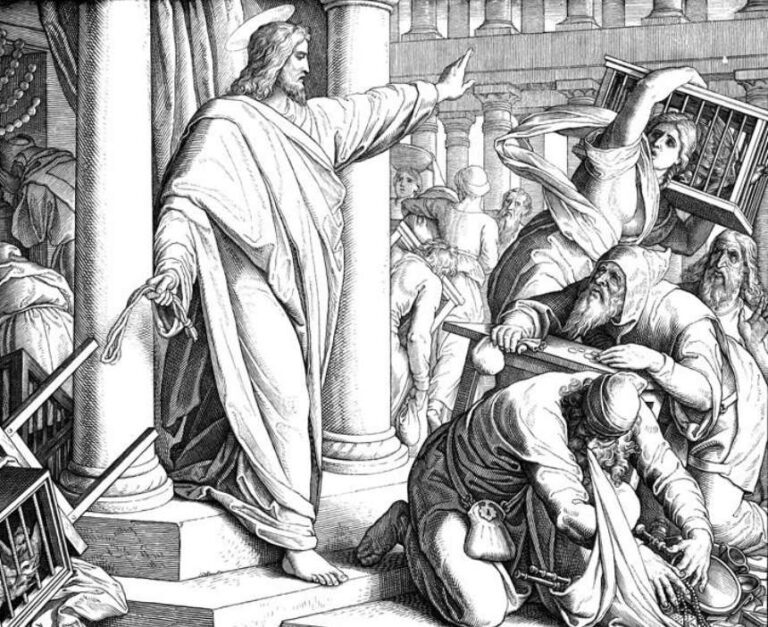
Straight from the Mount of Olives, Jesus enters the temple, a place meant for divine communion, only to find it transformed into a marketplace of spiritual exploitation. To understand the anger our Lord felt — the righteous fury that drove Him to overturn the tables — we must look at the historical and cultural landscape of first-century Jerusalem.
The temple was the center of Jewish life. It was the dwelling place of God on earth, His locality at the time. During major feasts, hundreds of thousands of pilgrims came there. According to the ceremonial law, worshippers had to offer sacrifices, and those sacrifices had to be inspected for blemishes by the priests. Every Jewish male also had to pay the annual temple tax, which could only be paid using the official temple currency, since foreign coins bearing the image of Caesar and pagan deities were deemed unlawful for use in the temple.
To accommodate this, the outer courtyard — the Court of the Gentiles — was turned into something like a bazaar, where money changers set up tables and merchants sold doves, sheep, and oxen. On paper it was convenient, but in practice it was a system built on greed and extortion. The priests and merchants had established many ways to extract money from people. If a pilgrim brought a perfectly good lamb from home, the temple inspectors would find something wrong with it, forcing him to buy an approved animal on site — at a marked-up price. The exchange rates for temple currency were heavily manipulated, effectively robbing the poor. This is part of why tax collectors were so despised: they extorted people in the same way.
Worst of all, this corruption took place in the Court of the Gentiles — the only space in the entire temple where non-Jews could seek the true God and pray. Instead of a house of prayer open to all nations, Gentiles were met with scamming, the shouting of merchants, the clatter of coins, and the stench of animals and manure. The nations were being driven away by the very religious establishment meant to point them to the true God.
Jesus’s anger was not a sudden, uncontrolled fit of temper. It was righteous indignation — the holy zeal of God incarnate, burning against an outrage in which, instead of offering God’s grace, the temple leadership sold it. It sounds remarkably familiar to what happened in Luther’s time.
When we look at this scene, we’re prone to simply blame the priests for being priests, for being religious. But this text is really about the human condition. We are often surrounded by material things, even as we, by baptism, are temples of the Holy Spirit. Material things in themselves are not evil — God created the physical world and called it very good. Food, money, homes, and technology are daily gifts of His providence. But what these things lead us to, and what we place in our hearts, matters eternally.
By nature, our hearts are idol factories, just as the temple courts were filled with stalls devoted to worldly convenience and transaction. Our hearts, too, are cluttered with the cares of this life, the deceitfulness of riches, and the desire for control. We try to monetize our relationships. We bargain with God, offering Him our good deeds in exchange for temporal blessings, crowding out the quiet space where His Word should dwell. We turn the sanctuary of our conscience into a den of thieves, harboring selfish ambition, greed, and self-righteousness, leaving no room for the brokenhearted to find comfort.
The ancient Church and the fathers of the Reformation understood the profound spiritual weight of this text. Reflecting on the commercialization of the temple, Saint John Chrysostom wrote that the merchants made the house of prayer a den of thieves, for they robbed the worshippers, caring more for their own worldly gain than for the salvation of souls. Martin Luther, preaching on the nature of true worship and the cleansing of the temple, constantly warned against turning God’s gifts into human works or commercial transactions. In his exposition on Christian worship, Luther noted that the temple of God is holy, and that we are that temple — and that Christ comes to purge His house, to drive out the self-righteous and the profit-seekers who rely on their own works rather than on His pure mercy.
Luther reminds us that whenever we try to barter with God, or use religion for our own status, comfort, or gain, Christ must come with His whip of cords. He must cleanse us, overthrow our self-made altars, and strip away our false securities.
So the Law of God exposes our idolatry, our love of the temporal over the eternal, and our complicity in a world system that preys on the vulnerable. We too have failed to recognize the time of our visitation. We deserve the judgment Jesus wept over — the leveling of our pride and the destruction of our self-righteous fortresses.
Yet here we have the Gospel still. Jesus did not drive out the buyers and sellers simply to leave an empty room. He remained in the temple, teaching daily. He drove out the merchants so that His house could once again be a house of prayer — a place where sinners find mercy.
When your heart is a den of thieves, weighed down by guilt and worldly distraction, look to where Christ promises to meet you today. He does not point you back to your own works, your own money, or your own moral currency. Instead, He points you to His Word and Sacraments. In the preached Word, He speaks absolute, unqualified forgiveness to your guilty conscience. In Holy Baptism, He has washed you and made your body a living temple of the Holy Spirit — not by the will of man, but by His grace. And in the Holy Supper, He feeds you not with the corruptible bread of this world, but with His true body and blood, given and shed for you for the forgiveness of sin.
Here, at His altar, there is no buying and selling. The grace of God is entirely free, purchased by the blood of the Lamb who wept for you, died for you, and rose for you. He cleanses your heart, silences your accusers, and grants you His everlasting peace.
And may the peace of God, which passes all understanding, keep your hearts and minds in Christ Jesus our Lord. Amen.